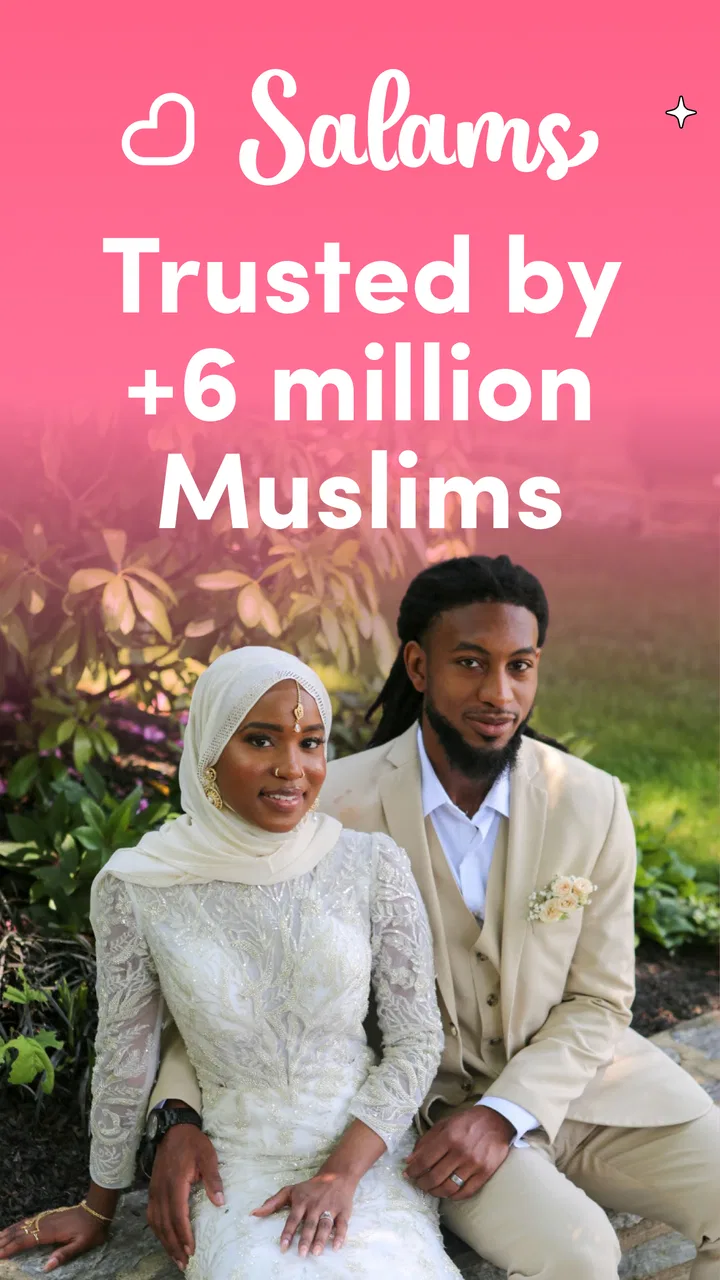
Salams: Halal Muslim Marriage
- 4.0
- Rating
- 1.00M
- Installs
- Free
- Price

 Analysis by App-foxy
I approached Salams: Halal Muslim Marriage less like a quick dating download and more like a tool that has to earn a regular place in someone’s life. Its purpose is clear: it brings Muslim marriage, friendship, and halal dating into one social app, with the hope that conversations can move toward something meaningful. That focus immediately separates it from broad dating services, where cultural and religious expectations may need to be explained before a conversation even begins.
My first impression was that the app makes sense for people who want their faith to be part of the starting point rather than an awkward subject introduced later. It is free to install, aimed at mature users, and developed by Affinity Apps, LLC. The audience is already substantial, with more than a million installs, a 4.0 average from roughly twenty-nine thousand ratings, and about one thousand one hundred written reviews. Those figures suggest a real user base, although they should not be mistaken for a guarantee that every local area will have an equally active pool of suitable matches.
From an appealing first week to a realistic long-term routine
I want to look beyond the initial excitement and consider what makes this kind of search sustainable: whether I can use the app with a steady rhythm, protect my attention, and still make room for offline life. That longer view also brings practical questions about comfort and access into focus, especially when people use Salams in very different settings.
You May Also Like

 Blood Strike: 2.5 Anniversary
Blood Strike’s Loadouts Turn Every Drop Into a Tactical Gamble
A close look at Blood Strike’s custom loadouts: how fast access to signature weapons reshapes its battle royale rhythm, rewards preparation, and narrows the gap between fights.

 Pandora - Music & Podcasts
Pandora’s Music Is Easy to Start, but Harder to Recover
Pandora’s strength is its low-effort path from a seed to a station. Its weak spot is how much confidence it asks you to place in connection, setup, and quiet recovery.

 8 Ball Pool
 Is Built on Rivalries, Rematches, and Routine
A close look at the rivalries, rematches, shared routines, and unanswered safety questions that turn a quick pool match into a persistent mobile community.

 Samsung Music
’s Quiet Strength Is Playing What You Already Own
Its reach comes less from spectacle than from dependable access to a personal library. That simplicity is both the app’s strongest retention engine and its ceiling.

 AccuWeather: Weather Radar
AccuWeather Review: A Quick, Clear Forecast for Everyday Decisions
For everyday plans, the best forecast is the one you can understand quickly. AccuWeather makes rain timing, radar, and local conditions easy to act on, with a few trade-offs.

 Hill Climb Racing
Why Hill Climb Racing Still Turns Crashes Into One More Run
A tiny car, a bumpy hill and one more upgrade: Hill Climb Racing keeps resurfacing because its simple chaos makes every near-miss feel personal.
More From Our News Desk



Why the first week feels promising
The strongest early appeal is the app’s narrow purpose. If I were looking for a spouse while trying to keep Muslim values, family expectations, and personal boundaries in view, I would find the focused environment more comfortable than a general-purpose dating app. The store summary describes Muslim marriage, Muslim friendships, and halal dating, and that combination gives the service room for different stages of social connection instead of forcing every interaction into a purely romantic frame.
That distinction matters in everyday use. A person may want to meet someone for marriage but still prefer to begin with a respectful conversation. Another user may be seeking community and friendship rather than an immediate proposal. Having those intentions under the same roof can reduce the pressure of pretending that every match must become a relationship. At the same time, the broad scope means I would pay close attention to each person’s actual goal instead of assuming that everyone is using the app in the same way.
During a first week, the novelty is easy to understand. There is a clear reason to open the app, a large enough overall audience to make browsing worthwhile, and a subject matter that feels more intentional than swiping through profiles with no shared context. The experience can be especially useful for Muslims who live in places where meeting compatible people through family, work, study, or a local community is difficult.
Still, I would not judge it after one enthusiastic evening. A social and marriage-focused app can feel full of possibility at first because every profile represents a new path. The more meaningful test is whether the conversations become better over time, whether the same patterns repeat, and whether the app helps users make sensible decisions rather than simply encouraging more browsing.
How I would use it in an ordinary week
Imagine someone with a demanding work schedule who wants to meet a Muslim partner without turning every weekend into a search for introductions. I would suggest setting aside a short, consistent period a few times a week rather than checking constantly. During that time, I would review profiles carefully, look for compatible intentions, and start only a small number of conversations. That approach makes the app part of a routine instead of allowing it to become an endless stream of notifications and half-finished chats.
The most useful early habit is to be direct without being abrupt. A profile should make it reasonably clear whether the person is thinking about marriage, friendship, or a more exploratory form of halal dating. In conversation, I would ask about practical expectations gradually: family involvement, location, religious practice, timing, and what each person considers a serious step. These questions are more valuable than trying to create instant chemistry through constant messaging.
One non-obvious trade-off is that a focused audience can improve relevance while also making mismatches feel more significant. Shared Muslim identity does not automatically mean shared culture, level of observance, personality, or plans for family life. I would treat the app as a way to find possible introductions, not as a shortcut around the work of learning whether two people truly fit.
What becomes valuable after the novelty fades
After the first few weeks, the app’s recurring value depends on whether it helps me make progress. A useful session should end with a clearer understanding of someone, a decision to continue, or a respectful decision to move on. If I am only collecting matches and reopening the app whenever I feel bored, the service is no longer helping me search; it is simply becoming another attention habit.
For serious users, the best long-term use is selective. I would keep conversations organized mentally by stage: new introduction, basic compatibility, deeper questions, and a possible move toward family awareness or an offline meeting. This workflow prevents the common problem of having many pleasant chats that never go anywhere. It also makes it easier to notice when someone avoids reasonable questions or keeps the relationship permanently vague.
The app’s friendship angle can add lasting value for people who are not ready for marriage immediately. It may provide a gentler entry point for someone new to a city, returning to social life, or hoping to meet Muslims outside an existing circle. However, that flexibility can also create uncertainty. If I were using it mainly for marriage, I would state that early and avoid spending weeks in a connection where the other person wants something entirely different.
Compared with general dating apps, the advantage here is context. I would spend less time explaining why halal boundaries or family considerations matter. Compared with relying only on introductions through relatives or community contacts, the advantage is reach and personal choice. The limitation is that an app cannot provide the trust, accountability, or shared knowledge that a respected mutual connection may offer. In my view, Salams works best alongside real-world judgment, not as a replacement for it.
The maintenance work users should expect
There is no way around profile maintenance if I want useful results. A vague profile creates vague conversations, while an overly polished one can feel impersonal. I would revisit the wording when my intentions change, remove signals that could be misunderstood, and make sure my expectations are expressed in ordinary language. This is not busywork: on an app centered on marriage and values, small ambiguities can waste a great deal of time.
Conversation maintenance matters just as much. I would avoid keeping inactive chats alive out of politeness, and I would close a conversation kindly when compatibility is not there. That reduces emotional clutter and leaves more attention for people who are genuinely engaging. It is also worth deciding in advance how quickly I am comfortable moving from in-app messages to a more serious stage. Rushing can create avoidable risk, while endless messaging can create a false sense of closeness.
Because the app is rated Mature 17+, I would still use adult judgment rather than treating the age label as a safety guarantee. I would protect personal information, be cautious with financial requests, and arrange any offline meeting in a public setting. I would also involve a trusted person when a connection begins to feel serious. These are especially important habits in a service where users may be discussing marriage, family, and personal circumstances.
Another practical consideration is the commercial model. The app is free, but it includes optional purchases ranging from ninety-nine cents to two hundred forty-nine dollars ninety-nine cents per item. I would begin without spending anything and first determine whether the available experience fits my needs. Anyone tempted by a premium option should ask what specific problem it solves and whether it improves the quality of matches or merely increases visibility and activity. A paid feature cannot create compatibility, honesty, or commitment.
The current version is 12.13.1 and it requires at least operating system version 9. I would keep the app updated when possible, particularly if I rely on it for ongoing conversations. More importantly, I would review my own usage every few weeks. If I am opening it automatically but not having worthwhile exchanges, taking a break may be healthier than trying to force value from it.
Where long-term fatigue comes from
The first source of fatigue is repetition. Even with a large overall audience, browsing can begin to feel similar when profiles use broad phrases without enough personal detail. The responsibility then falls on me to filter thoughtfully, but that process takes energy. If the local pool is small, the feeling of seeing familiar or unsuitable profiles can arrive much sooner than the app’s total install count might suggest.
The second source is emotional uncertainty. Marriage-oriented conversations carry more weight than casual small talk. A promising exchange can stop without explanation, or two people can discover a major difference only after investing considerable time. Salams can make introductions easier, but it cannot remove disappointment or guarantee that users communicate with the same level of seriousness.
A third issue is the tension between broad inclusion and clear intention. Supporting friendship, marriage, and halal dating makes the app approachable, but it also means I must clarify what each match wants. Someone seeking a spouse may become frustrated by conversations that remain casual, while someone seeking friendship may feel pressured by users who move too quickly. The app is not necessarily failing in either case; the mismatch comes from using a flexible space without discussing expectations.
I would also be careful about confusing religious compatibility with complete compatibility. Shared faith can be a strong foundation, yet differences in culture, language, family expectations, finances, geography, and lifestyle can matter just as much. The app is not the right choice for anyone hoping that a religious label alone will do the difficult work of relationship evaluation.
Who will get the most from it
I think the service is a strong candidate for Muslims who are intentional about meeting people, want faith-aware context, and are willing to communicate clearly. It suits someone who has limited access to introductions, prefers to make their own choices, or wants to broaden a local social circle while keeping marriage and halal boundaries in view.
It is also useful for a person who can tolerate a gradual process. The best results are unlikely to come from treating every match as a potential life partner immediately. A calmer approach—screening for intentions, asking meaningful questions, and moving forward only when actions match words—makes the app more manageable and more respectful.
I would recommend skipping it, or at least postponing it, if someone is looking for instant certainty, constant entertainment, or a completely hands-off experience. It is not ideal for users who dislike clarifying intentions, who want a family or community member to handle introductions entirely, or who are uncomfortable with the emotional effort of rejecting and being rejected. A local mosque, community group, trusted relatives, or a general dating service may be better depending on the person’s priorities.
My lasting verdict
Salams earns a place on my phone when I treat it as a focused introduction tool rather than a magical matchmaking solution. Its first-week appeal comes from putting Muslim marriage, friendship, and halal dating into a setting where those subjects are understood from the beginning. Its month-to-month value comes from disciplined use: clear profiles, selective conversations, honest boundaries, and a willingness to move on when the fit is wrong.
The maintenance burden is real. I need to keep my intentions current, manage conversations, protect my privacy, and resist paying simply because browsing has become frustrating. The experience can become tiring when the audience near me is limited, when conversations lack direction, or when shared faith is mistaken for full compatibility. Those are not small concerns, and they mean the app will not suit everyone.
Even so, I see a durable role for it among users who want a Muslim-centered alternative to general dating apps and who are prepared to do the human work beyond the screen. The 4.0 average and established audience make it reasonable to try, while the free entry point keeps that trial accessible. I would start slowly, spend nothing until the basic experience proves useful, and judge success by the quality and progress of conversations—not by the number of matches.
My final recommendation is therefore measured but positive: try it if your search is serious, your expectations are clear, and you value a faith-aware starting point. Keep it if it consistently helps you meet compatible people and make thoughtful decisions. If it becomes an endless cycle of browsing without progress, step back and combine it with trusted offline connections. The app can open the door, but lasting value comes from how deliberately you choose to walk through it.
FAQs for Salams: Halal Muslim Marriage
01What is Salams: Halal Muslim Marriage, and who is it designed for?
Salams is a Muslim-focused matchmaking app designed for people seeking marriage and meaningful, faith-conscious relationships. It allows users to create a profile, describe their religious practices and preferences, and discover potential matches based on factors such as location, lifestyle, values, and marriage intentions. It is generally more suitable for users seriously considering marriage than for casual dating.
02How does matching and messaging work on Salams?
After creating a profile, you can browse suggested members and indicate interest in people who match your preferences. Messaging is typically available when interest is mutual, helping limit unwanted conversations. Users can discuss important topics such as faith, family expectations, education, career plans, and future goals. However, matching results depend heavily on your location, profile quality, preferences, and the number of active members nearby.
03Does Salams offer privacy and safety features for Muslim users?
Salams includes features intended to make online matchmaking more comfortable, such as profile controls, reporting and blocking tools, and options that help users manage who can contact them or view certain information. Some members may also involve a wali, family member, or trusted companion in the process. Even with these tools, avoid sharing sensitive details too quickly, verify someone’s identity, and report suspicious behavior.
04Is Salams free to use, or does it require a subscription?
You can usually download Salams and create a profile without paying, with access to basic browsing and matchmaking functions. However, certain advanced features may require in-app purchases or a premium subscription. These can include enhanced visibility, additional preferences, or tools that make it easier to review previous activity. Pricing and available features may vary by country, platform, and promotional offer, so check the current store listing before subscribing.
05What should I include in my Salams profile to find better matches?
A complete and honest profile generally produces better conversations than a profile with only a few details. Use recent photos that represent you appropriately, explain your religious values and marriage intentions, and mention practical expectations such as location, family involvement, education, or lifestyle. Avoid exaggerating your qualities or hiding important information. Clear communication from the beginning can help you identify compatible matches and avoid unnecessary conversations.
Pros
- Profile verification features help reduce fake or misleading accounts.
- Detailed religious and lifestyle preferences improve match relevance.
- In-app voice and video calls enable safer first conversations.
- Privacy controls let users manage profile visibility and contact options.
- Useful filters help narrow matches by location
- education
- and practice.
Cons
- Many meaningful interactions require a paid subscription or premium credits.
- The user base may be smaller outside major Muslim communities.
- Some profiles contain limited information
- making compatibility harder to judge.
- Match quality can vary depending on how accurately users complete profiles.
- Notifications and repeated match suggestions may feel excessive for some users.

Salams: Halal Muslim Marriage
Gallery